
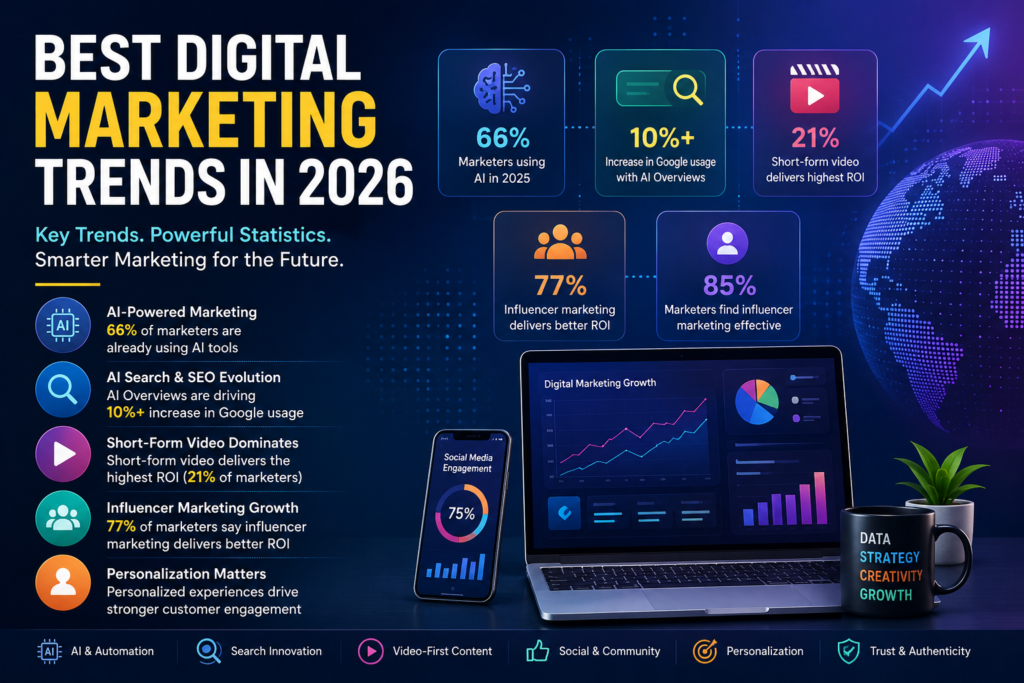
Digital marketing is changing faster than ever. Artificial intelligence, short-form video, social commerce, search innovation, and data-driven personalization are reshaping how businesses attract customers online. For brands that want to remain competitive in 2026, simply having a website and running advertisements is no longer enough.
Here are the most important digital marketing trends businesses should watch in 2026, backed by recent industry statistics and research.
1. Artificial Intelligence Is Becoming a Core Marketing Tool
Artificial intelligence has moved from being an experimental technology to an everyday marketing tool. Marketers are using AI for content creation, customer research, data analysis, campaign ideas, personalization, and automation.
According to HubSpot’s 2025 research, 66% of marketers globally were already using AI in their roles. Content creation was one of the most common applications, with marketers using AI to create copy, images, ideas, and other marketing assets.
The important trend for 2026 is not simply “using AI to write content.” Businesses are increasingly combining AI with human expertise to produce content faster while maintaining originality, brand voice, and credibility.
What businesses should do: Use AI for research, brainstorming, content repurposing, analytics, automation, and personalization—but keep human review and strategic thinking at the center.
2. SEO Is Evolving Into AI Search Optimization
Search engine optimization is changing because people are increasingly receiving answers directly from AI-powered search experiences.
Google has expanded AI Overviews to more than 200 countries and territories and more than 40 languages. Google also reports that in major markets such as the U.S. and India, AI Overviews are driving more than a 10% increase in Google usage for the types of searches where AI Overviews appear.
This means businesses need to think beyond traditional rankings. Content should be structured so that search engines and AI systems can easily understand the topic, identify trustworthy information, and connect the content with relevant user questions.
What businesses should do: Focus on helpful, original content, strong topical authority, clear answers, structured information, first-hand expertise, internal linking, and authoritative references.
3. Short-Form Video Continues to Dominate
Short-form video remains one of the strongest digital marketing formats across platforms such as Instagram, YouTube, and TikTok.
HubSpot’s 2025 marketing research found that short-form video was the content format delivering the highest reported ROI, with 21% of marketers selecting it. It was also the most-used content format, with 29% of marketers reporting its use.
Video marketing is also widely adopted. HubSpot’s compilation of 2025 video marketing research reports that 89% of businesses use video marketing, while 93% of marketers consider video an important part of their overall strategy.
What businesses should do: Create short educational videos, product demonstrations, customer stories, behind-the-scenes content, FAQs, and quick industry tips. One long-form piece of content can also be repurposed into multiple short videos.
4. Social Media Is Becoming a Search and Discovery Channel
Social media is no longer only about posting updates and building followers. Users increasingly discover brands, products, restaurants, services, and information through social platforms.
HubSpot’s research found Instagram, YouTube, and TikTok among the strongest platforms for driving traffic, engagement, and audience growth. Instagram led the survey for site traffic, engagement, and audience growth.
This creates an opportunity for businesses to optimize social profiles and content similarly to how they optimize websites.
What businesses should do: Use descriptive captions, relevant keywords, strong hooks, searchable titles, location information where relevant, and content that directly answers customer questions.
5. Influencer Marketing Is Moving Toward Micro-Creators
Influencer marketing is becoming more focused on authenticity and niche communities rather than simply choosing celebrities with millions of followers.
HubSpot reports that 77% of marketers said influencer marketing delivers better ROI than other channels, while 85% considered it effective. The research also found that 67% of marketers work with micro-influencers.
For smaller businesses, this can be particularly valuable because niche creators often have highly engaged audiences.
What businesses should do: Partner with creators whose audience matches the target customer rather than choosing influencers based only on follower count.
6. Personalization and First-Party Data Will Become More Important
Customers increasingly expect brands to understand their needs and provide relevant experiences. At the same time, businesses need to become more careful about privacy and how customer information is collected and used.
The future of digital marketing will therefore combine personalization with responsible first-party data collection.
Businesses can use website interactions, email subscriptions, purchase history, customer surveys, and CRM data to understand audiences while maintaining appropriate consent and privacy practices.
What businesses should do: Build email lists, improve CRM systems, segment audiences, and personalize campaigns based on genuine customer behavior.
7. AI + Human Creativity Will Be the Winning Combination
The biggest digital marketing trend may not be AI replacing marketers—it is marketers who know how to use AI effectively outperforming those who do not.
HubSpot’s research found that 72% of marketers in its global social media trends research reported better performance with AI-assisted content, while 71% reported actively using AI tools in social media marketing.
However, automated content alone is unlikely to create a strong brand. Original experiences, expert opinions, customer stories, creativity, and trust remain important differentiators.
Conclusion
The digital marketing landscape in 2026 is centered around AI, search innovation, video, social discovery, influencers, personalization, and authentic content.
Businesses should not try to chase every new platform or technology. Instead, they should build a strong foundation around valuable content, search visibility, social media, customer data, and measurable campaigns.
The brands most likely to succeed will be those that combine technology with human creativity and customer understanding.
Digital marketing is no longer simply about reaching more people. It is about reaching the right people, in the right place, with the right message—and increasingly, using AI to do it faster and smarter.
Sources: HubSpot, Google Search, Google India, and industry research referenced throughout this article.
