Organic Growth in 2026: Benefits, Strategies and Why It Matters for Businesses
In today’s competitive digital world, businesses are constantly looking for ways to attract customers without depending entirely on paid advertising. While Google Ads, social media advertising, and other paid campaigns can generate quick results, organic growth offers something much more valuable in the long term: sustainable visibility and customer trust.
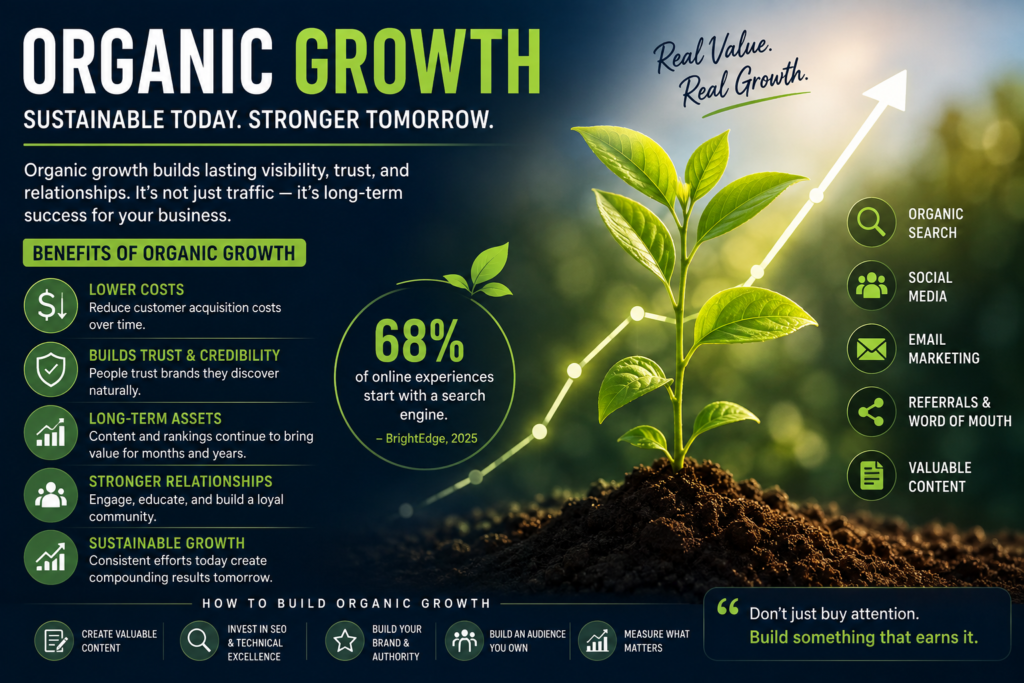
Organic growth refers to increasing website visitors, leads, customers, brand awareness, and revenue through unpaid channels such as search engines, social media, referrals, communities, email, and valuable content.
For businesses that want to build a strong digital presence in 2026, organic growth should be an important part of their marketing strategy.
What Is Organic Growth?
Organic growth is the process of growing a business naturally through customer discovery, valuable content, search visibility, word-of-mouth, social engagement, referrals, and other channels that do not require direct payment for every visitor or interaction.
For example, when someone searches Google for “best digital marketing agency,” discovers your website, reads your article, and eventually contacts your business, that customer acquisition can be considered part of organic growth.
Similarly, a customer discovering your Instagram page through a shared post, subscribing to your newsletter, or recommending your business to a friend can contribute to organic growth.
The objective is not simply to generate traffic. It is to build an audience that continues to discover, trust, engage with, and recommend your brand.
Why Is Organic Growth Important Today?
The digital landscape is becoming increasingly expensive and competitive. Businesses are competing for advertising space across Google, Meta, YouTube, TikTok, LinkedIn, and other platforms.
Organic channels can provide an important counterbalance.
BrightEdge’s research published in 2025 found that AI search was growing rapidly but still accounted for less than 1% of referral traffic in its dataset, while organic search remained the primary driver and produced stronger conversion performance.
This demonstrates an important point: new technologies are changing how people discover information, but traditional organic visibility remains highly valuable.
1. Lower Customer Acquisition Costs
One of the biggest advantages of organic growth is that you don’t necessarily have to pay for every visitor.
With paid advertising, stopping your campaign generally stops the flow of paid traffic. Organic content can continue attracting visitors after it has been published.
A well-optimized article, YouTube video, social media post, or resource page can potentially generate traffic for months or even years.
This does not mean organic marketing is free. Businesses still need to invest in strategy, content creation, SEO, tools, and expertise. However, the economics can become more attractive as a strong content and search presence compounds over time.
2. Builds Trust and Credibility
People are increasingly exposed to advertisements everywhere they go online. Organic discovery can feel more natural because users actively find information rather than simply being shown an advertisement.
Google’s current guidance emphasizes helpful, reliable, people-first content and recommends demonstrating first-hand expertise, originality, and trustworthiness.
For businesses, this means creating content that genuinely solves customer problems instead of producing articles simply to rank for keywords.
Educational guides, case studies, tutorials, original research, customer experiences, and expert opinions can help establish authority.
3. Creates Long-Term Digital Assets
Paid advertisements are campaigns. Organic content can become an asset.
For example, a company that publishes 100 useful articles over several years is building a searchable knowledge base that can continue generating visibility.
HubSpot’s 2025 blogging research found that 66% of businesses maintaining blogs publish content for brand awareness, 53% for customer engagement, and 49% for lead generation.
This shows that blogging is not only about SEO. Businesses also use content to build awareness, engage audiences, and generate potential customers.
4. Organic Growth Can Support Multiple Channels
A strong organic strategy does not have to depend exclusively on Google.
One piece of content can be transformed into multiple formats:
- Blog article → LinkedIn post
- Blog article → Instagram carousel
- Research → YouTube video
- Video → Short-form clips
- Customer question → FAQ article
- Case study → Social media content
- Blog → Email newsletter
HubSpot’s research found that 83% of businesses with blogs distribute their content through social media, while 47% use email newsletters.
This makes content repurposing an important strategy for businesses trying to maximize the value of their marketing efforts.
5. Organic Search Still Matters in the AI Era
Artificial intelligence is changing search, but businesses should not assume that SEO is dead.
Instead, SEO is evolving.
Google recommends creating content primarily for people rather than producing large quantities of content simply to attract search traffic. Its guidance also emphasizes original information, comprehensive answers, first-hand expertise, and clear authorship where appropriate.
The future of organic growth therefore involves creating content that can perform across traditional search engines, social platforms, and AI-powered discovery experiences.
How to Build an Organic Growth Strategy
A successful organic growth strategy can be built around five core areas:
1. Create valuable content: Answer real questions your target customers are asking.
2. Invest in SEO: Research search intent, optimize important pages, improve internal linking, and maintain strong technical SEO.
3. Build your brand: Develop recognizable expertise through consistent content and communication.
4. Build an audience you own: Encourage visitors to subscribe to newsletters, communities, or other direct communication channels.
5. Measure business outcomes: Don’t focus only on pageviews. Track leads, conversions, revenue, returning visitors, rankings, engagement, and customer acquisition costs.
Organic Growth vs Paid Marketing
Organic and paid marketing should not necessarily be treated as competitors.
Paid advertising can provide immediate visibility and help businesses test offers, audiences, and messaging. Organic marketing can build long-term visibility, authority, and trust.
The strongest strategy for many businesses is therefore a combination of paid and organic marketing.
Use paid campaigns when you need speed. Build organic channels when you want sustainable growth.
Conclusion
Organic growth has become more important, not less, in today’s digital environment.
Businesses are facing rising competition, changing search behavior, increasing advertising costs, and the rapid growth of AI-powered discovery. In this environment, brands that consistently provide useful information and build genuine relationships with their audiences can create a significant long-term advantage.
Organic growth is not a shortcut. It requires patience, consistency, quality, and measurement.
But when done correctly, every useful article, video, search ranking, social interaction, customer review, email subscriber, and referral can become part of a larger digital ecosystem that continues working for the business.
The goal of organic growth is simple: don’t just buy attention—build something that earns it.
